

What Is Physics, Really?
An attempt to explain everything around us, the universe and maybe even ourselves. Here’s what makes physics more than just an idea about the world.
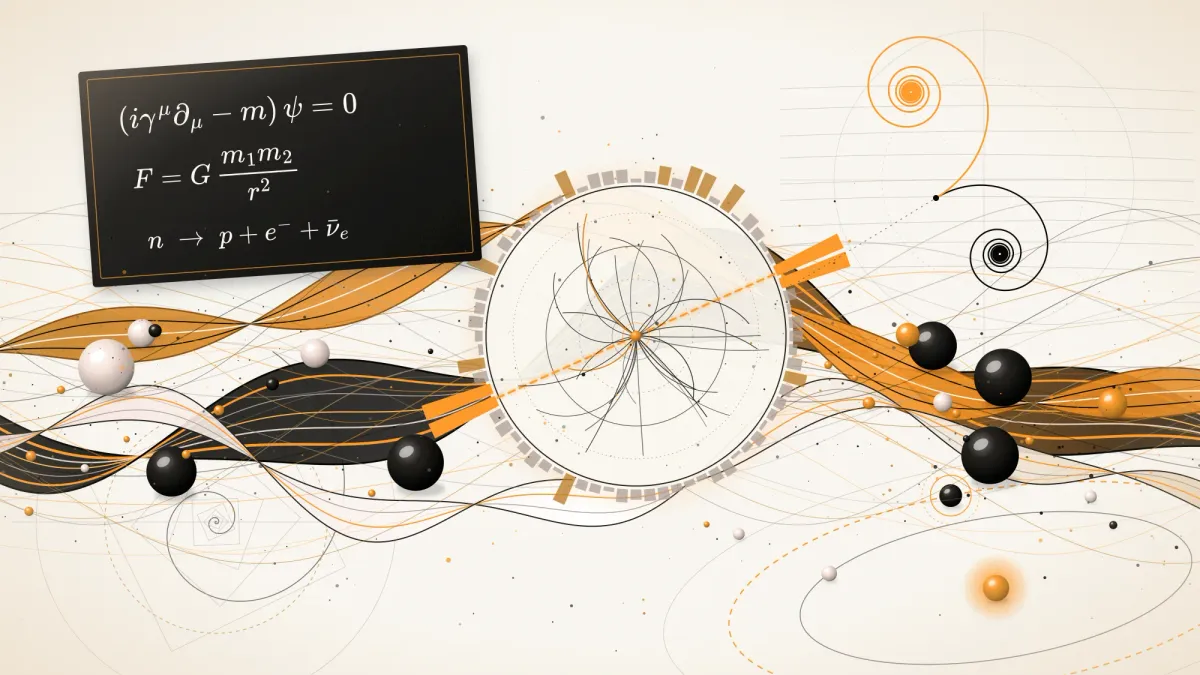
Physics is an attempt to explain everything around us: the objects we touch, the light we see, the universe as a whole, and perhaps even ourselves.
That sounds a lot like philosophy, and you’d be right to say so. So let me tell you a secret: physics is philosophy. More precisely, it’s its natural evolution. For centuries, the people we now call physicists were called natural philosophers, and Isaac Newton titled his masterpiece Mathematical Principles of Natural Philosophy.
There is one difference, though, and it changes everything. In physics, an idea can’t simply be believed on someone’s word. Anyone, anywhere, must be able to check it for themselves.
A universal language
To make ideas checkable, you need a language that leaves as little room as possible for interpretation. That language is mathematics.
Mathematics is, in a sense, the most primordial of languages: quantities, shapes, relations, cause and effect. Many people find it intimidating, scared off by strange symbols, letters and numbers. If you ask me, that’s the school system’s fault, not mathematics’. Underneath the symbols there is something remarkably simple: a way of saying exactly what you mean, so that everybody understands exactly the same thing.
Galileo put it better than anyone, four centuries ago: the book of nature “is written in the language of mathematics”.
How a theory is built
Using this language, a physicist lays out a way of seeing the world in a few steps.
First come the axioms: a small set of rules taken as true, because that is what experience has taught us so far. Then, starting from those rules, logical connections take you from one statement to the next, one step at a time, building up a whole view of a phenomenon.
The beauty of the process is that it doesn’t just describe your view: it hands the reader every tool needed to walk the same path and reach the same conclusions, without having to trust you. That, in essence, is a theory.
What makes a theory scientific
Not every theory is a scientific one. To earn that label, it has to meet a few precise criteria:
- Logical consistency. It must not contradict itself: from the same assumptions you can’t derive both a statement and its opposite.
- Testability. Its claims must be checkable through observation or experiment, and the results must be reproducible by anyone who repeats the measurement independently.
- Falsifiability. It must say clearly what would prove it wrong. As the philosopher Karl Popper argued, a theory that no experiment could ever contradict isn’t more solid: it simply isn’t science.
- Agreement with what we already know. A new theory must reproduce the successes of the one it replaces. Einstein’s relativity, for example, gives back Newton’s mechanics at everyday speeds.
- Economy. Among explanations that work equally well, we prefer the one with the fewest assumptions: the famous Occam’s razor.
You might expect “provable” on this list. It isn’t, and that’s one of the most fascinating things about science. Mathematics proves theorems; nature doesn’t sign certificates. A theory is never proven true once and for all: it survives the tests we throw at it, and the more tests it survives, the more we trust it. It always stays open to the next experiment.
Explaining is not enough
Suppose a theory is consistent and actually explains what we observe. Done? Not for a physicist.
The problem is that another theory, built on different assumptions, might explain the very same phenomenon just as well. With two equally convincing explanations, how do we know which one is right?
This is where physics asks for something more: a theory must predict. It has to bring something new to the table, consequences that follow from the theory itself and that nobody had looked for, and those consequences must be tested experimentally. If the prediction fails, the theory is in trouble. If it comes true, the theory earns something no amount of after-the-fact explanation can buy.
History is full of such moments.
Neptune (1846). Urbain Le Verrier noticed that Uranus wasn’t moving quite as Newton’s gravity said it should, and calculated where an unseen planet had to be to explain the difference. Johann Galle pointed his telescope at that spot and found Neptune on the very first night, less than a degree from the predicted position.
Antimatter (1928–1932). Paul Dirac wrote an equation bringing together quantum mechanics and special relativity to describe the electron. It also had solutions that seemed to make no physical sense. Rather than throwing them away, Dirac took them seriously: they implied a particle identical to the electron, but with opposite charge. In 1932 Carl Anderson spotted it in cosmic rays. It was the positron, the first antiparticle ever observed, and the door to antimatter.
The neutrino (1930–1956). In some radioactive decays, energy seemed to vanish into thin air, as if its conservation, one of the pillars of physics, were failing. In 1930 Wolfgang Pauli proposed what he himself called a desperate remedy: an invisible particle, neutral and very light, carrying the missing energy away. He feared it could never be detected. It took 26 years and a nuclear reactor as an intense source before Clyde Cowan and Frederick Reines finally caught it, in 1956.
The Higgs boson (1964–2012). A theory of how particles acquire their mass predicted the existence of a new particle. It took almost fifty years and the largest machine ever built, the Large Hadron Collider at CERN, but on 4 July 2012 the Higgs boson was finally observed.
In every one of these stories, the mathematics saw it first.
Where this leaves us
This is Physics: not a collection of formulas to memorise, but a method. A shared, rigorous and endlessly curious way of asking questions about the world, and letting nature answer.
This post is the starting point of the Physics section. From here, we’ll use these tools to explore ideas, phenomena and theories, one step at a time.